
Firstly, I should preface, that this essay is not an argument against wealth, nor is it an attempt to vilify it. Wealth has always played a role in the cultivation, and definition of fashion, art and culture. What interests me, however, is the point at which it begins to influence the culture itself, rather than merely granting access to it, and this essay is my opinion on that point.
What first prompted this question for me was this year’s Met Gala, where Jeff Bezos and Lauren Sánchez Bezos served as honorary co-chairs and principal sponsors. The Met Gala is arguably the most prestigious event in the fashion calendar (although I have not watched it for around 6 years). It is an evening in which designers, artists, editors, celebrities and cultural figures converge under the eyes of the world’s media at the Metropolitan Museum of Art in New York. Yet this year, the presence of one of the world’s wealthiest men and his wife Lauren at the centre of the event felt like a confirmation of a shift. The Bezos’ were attending the Met as admirers of fashion and art, and also because their financial power directly constructed the event. I should note though, I actually do really like Lauren. She advocates for dyslexia and ADHD, is an author, owns a production company and knows how to fly a helicopter. I think that’s badass.
On the other hand, that distinction of why they attended is what interests me greatly. As an avid admirer of traditional fashion, art and culture structures, and the positions of power that define them, the case of the Bezos’ (and beyond) is captivating. Now, there is actually nothing new about wealthy people attending fashion events. Fashion, Art, Culture and that which promotes it has always been costly. My question is what happens when the people funding these institutions actually start to occupy positions that determine what exists within them. There is indeed a difference. And perhaps the most revealing reaction was not the presence of the Bezos’, but the people who were absent.
One of my favourite figures within the fashion scene Lauren Santo Domingo, founder of Moda Operandi and a longstanding figure within the industry, was notably absent from this year’s Met Gala, alongside high profile designers like Nicolas Ghesquière (Louis Vuitton Womenswear) and Jonathan Anderson (CD of Dior and founder of JW Anderson). LSD’s absence was widely linked to the backlash that arose surrounding the Bezos involvement in the event. This symbolism is difficult to ignore. Santo Domingo is not an outsider to the Met Gala. She co-chaired it in 2013 and has attended ever since, until this year. In my eyes she represents the fashion world that existed long before technology billionaires began occupying its spaces. So her absence suggests a level of disapproval towards the two spaces merging.
I want to first loosely define Culture. It was often defined by people who created something before anyone knew that it mattered. Young designers like Elsa Schiaparelli challenged established female silhouettes. Artists like Basquiat rejected conventional ideas of what made art beautiful, and photographers like Testino developed new visual languages of joy and dynamism within fashion. Lastly, writers and editors decided which of these kind of people deserved attention.
Focusing on Jean-Michel Basquiat for example, his relevance within culture did not begin with an established position within the art world. Rather it came from his work and paintings that had emerged from a particular artistic and social moment and, eventually, helped define it. The same can be said of generations of designers who changed fashion by introducing ideas that initially sat outside the so-called ‘norm’.
As I have mentioned above, editors like Anna Wintour (Not so much now), Franca Sozzani and André Leon Talley were among the figures who possessed huge cultural authority within fashion, and who people like me greatly admire. As their power did not simply come from money, it came from a good eye, expertise, experience and their positions within institutions that had the power to elevate a designer, photographer or model into the mainstream of culture. Sozzani, who edited Vogue Italia from 1988 until her death in 2016, absolutely transformed the magazine through experimental photography and imagery, while advocating for photographers and creative talent who helped establish the magazine as an inspiration within the Vogue space.
Interestingly, we could say that their authority was not necessarily ‘fair’ per-se. In fact, I saw someone on YouTube call them ‘gatekeepers’. I think that is exactly who they were. They decided what was worthy of attention and, consequently, events like the Met Gala felt exciting and special because the expertise of the fashion industry was to be put on show for the public. Now it seems to me, to be a watered down stage for celebrities to parade exclusiveness. But it’s not exclusive anymore because it has let money define what it is.
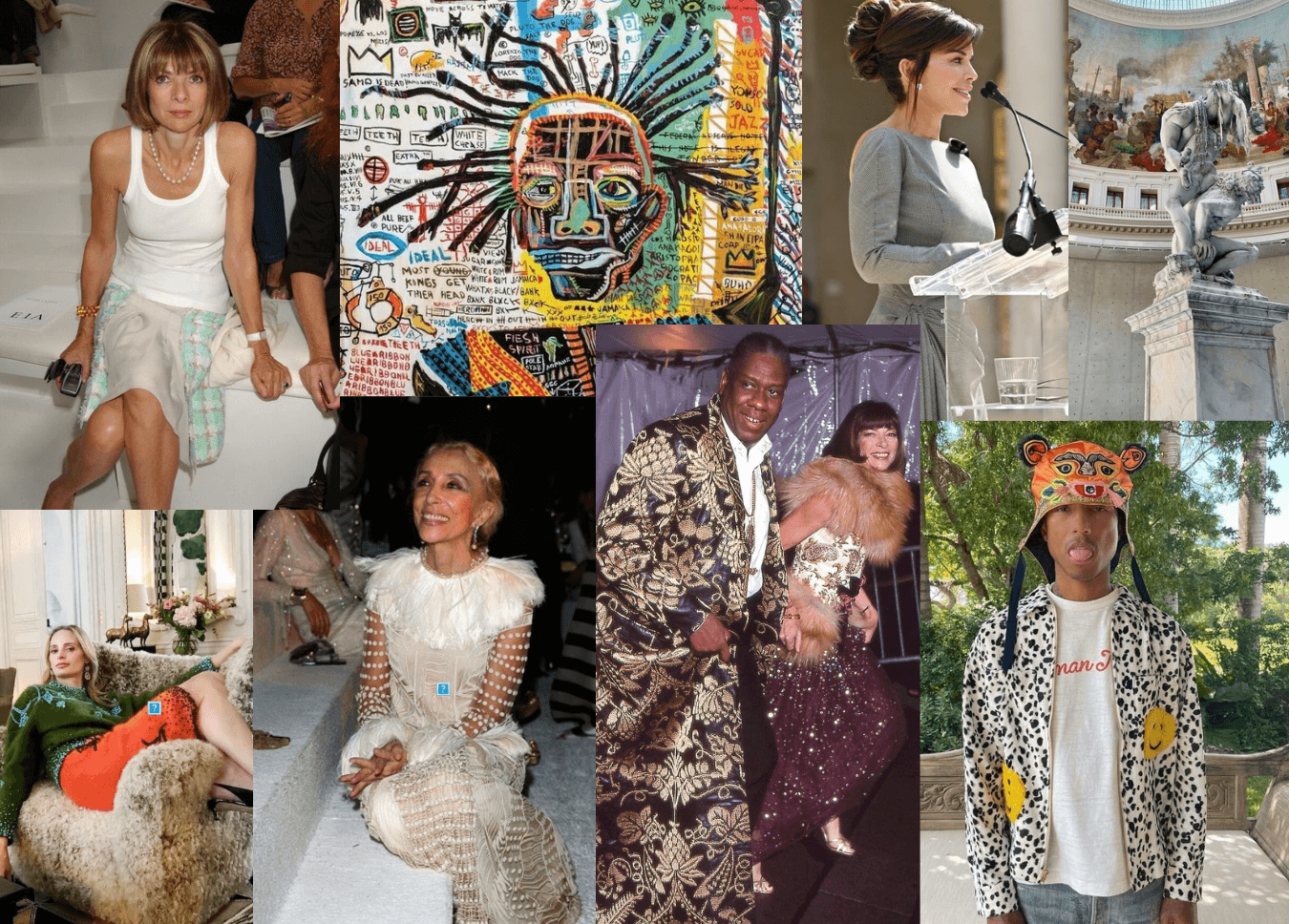
This does, however, make me question what has happened to the authority of Vogue itself. By putting celebrities like Kim Kardashian on its cover and then giving Lauren Sánchez Bezos such a significant platform, has Vogue not, in some sense, surrendered some of the authority it once had over taste? Vogue was once the pinnacle of fashion judgement. When that same institution begins to give its platform to people whose influence comes largely from commercial reach, I think it becomes harder to distinguish between culture and commercialism. Perhaps that is simply what fashion looks like now, it is under the grasp of celebrity culture. But I do find it sad that the magazine which once had the power to dictate taste now seems increasingly interested in reflecting whatever already has the greatest amount of attention and money, not who deserves it.
This is a stark difference to simply letting wealth fund it. Wealth has indeed funded museums, art collections and allowed institutions who house culture to survive. Similarly, if we consider the modern art market, a wealthy individual purchasing a painting for £100 million is not necessarily determining that the painting is culturally important. They may simply believe it is, based on advisory or trend. Conversely, when am enormous sum of money repeatedly flow towards particular artists, movements etc the financial value attached to their work can begin to influence the attention it receives rather than its actual content, and the process it took to get there.
If we really want to stretch this argument out further we could look to the rise of AI. Through this method of production ‘things’ have become more easy. Photoshoots, ideas, design and productivity has become something that does not require a whole team or much time, to produce. To me, this then reads as the erosion of creativity, at least in a human sense. AI has therefore risen the bar and expectations of what creativity is because it can, itself, be creative. Whilst before, advertising and image production, in magazines for instance, required a whole team to produce them and therefore led to ideas to overcome limitations. But AI changes that relationship with limitation. One person can now ‘create’ an image in seconds that previously might have required an entire creative team. I hate this because I think something extremely important is being lost.
These limitations are, in my opinion, what give such works their cultural significance and respect, and humans their beautifully unique trait of creativity compared to other species. We value Michelangelo's David sculpture not because it only looks exquisite, but because it had required extraordinary human skill and labour to produce. This is what humans are capable of and their genius does not require the help of Artificial Intelligence. This is not to say that AI is evil, I just think that the process of ideas and the acquired knowledge that comes with it is not as respected as it used to be. Let’s just say, I think there is a big discrepancy between Marcus Aurelius’ ‘Meditations’ and a piece of philosophical writing produced by ChatGPT. There is no personal context and ambition attributed to it like the former.
So the concluding question I have for you, is who exactly defines taste and culture today? Is it the young designer who made something out of nothing? The artist that spent years painting? Is it the celebrity who wears his clothes or buys the art? The editor who writes an article on these pieces? Or the individual who funds the platform?
All of these are interesting features of a new cultural shift that continues to fascinate me.
If it was worth your time
What did you make of it?
There are many ways to read a piece of writing and I would like to hear yours — agreement least of all. Whatever you leave sits under this essay only.
Loading…
When there is a new essay
I write when I have something worth saying, which is not often. Leave your email and I will tell you when the next one is up. Nothing else.