
The Body as a Canvas: Why Fashion Is a Form of Art
Fashion is not secondary, or a different entity to art, it is art, because it is lived, and continually changed in real time. In this instance, this occurs on the body, rather than a canvas.
Fashion has always existed in a space that blurs the boundaries between practicality and expression, yet it is often separated from the world of 'fine art', or simply, art, and it's cultural discourse. In my opinion, reducing clothing to mere function overlooks one of its most powerful capabilities. Fashion's ability to communicate identity, emotion, and narrative through silhouette, texture, and colour. Fashion is not secondary, or a different entity to art, it is art, because it is lived, and continually changed in real time. In this instance, this occurs on the body, rather than a canvas.
Fashion operates through the same visual and conceptual principles as painting and sculpture, for example. Rules of composition, balance, contrast, and texture are not exclusive to the canvas or the gallery space as they are equally present in the way garments move and interact with our bodies. Clothing becomes a visual language and indicator. The body becomes a site of composition. What is worn is never unknown, it has meaning. One's first impression of another includes their garments. Before a word is spoken, clothing has introduced a version of the self into the room. Dress shapes perception not as a lack of identity, but as a statement suggesting the mood and personality of oneself toward the world. Thus, there is almost an immediacy to this reading of the body that makes fashion powerful as a communicative form.
It is precisely this that makes personal style become deeply autobiographical. For instance, my own style reflects an instinct toward fashion as expression, rather than concealment. My love for silhouettes that flow with the lines of the body, intricate patterns, eccentric jewellery, beading and bright colours are central to me as a person. I feel most myself when I show this to the world around me. These choices are not decorative afterthoughts to me, but they are central to how my identity is constructed and received by others. Getting dressed becomes a daily form of authorship, something that is forgotten, or often related back to the kind of art we see in galleries.
This is also, I find, what makes the absence of stylistic choices in others equally compelling. Not everyone engages with clothing as overt expression, or a particularly important part of who they are, and that choice itself becomes interesting to me. It raises questions about their intentions, like what this rejection communicates in a culture that is increasingly image-driven? Whether eccentric or minimal, dress always participates in creating something. Perhaps this is the reason why designers, like Jonathan Anderson for instance, dress in overly simplistic clothing, because their clothes on the runway speak to who they are.
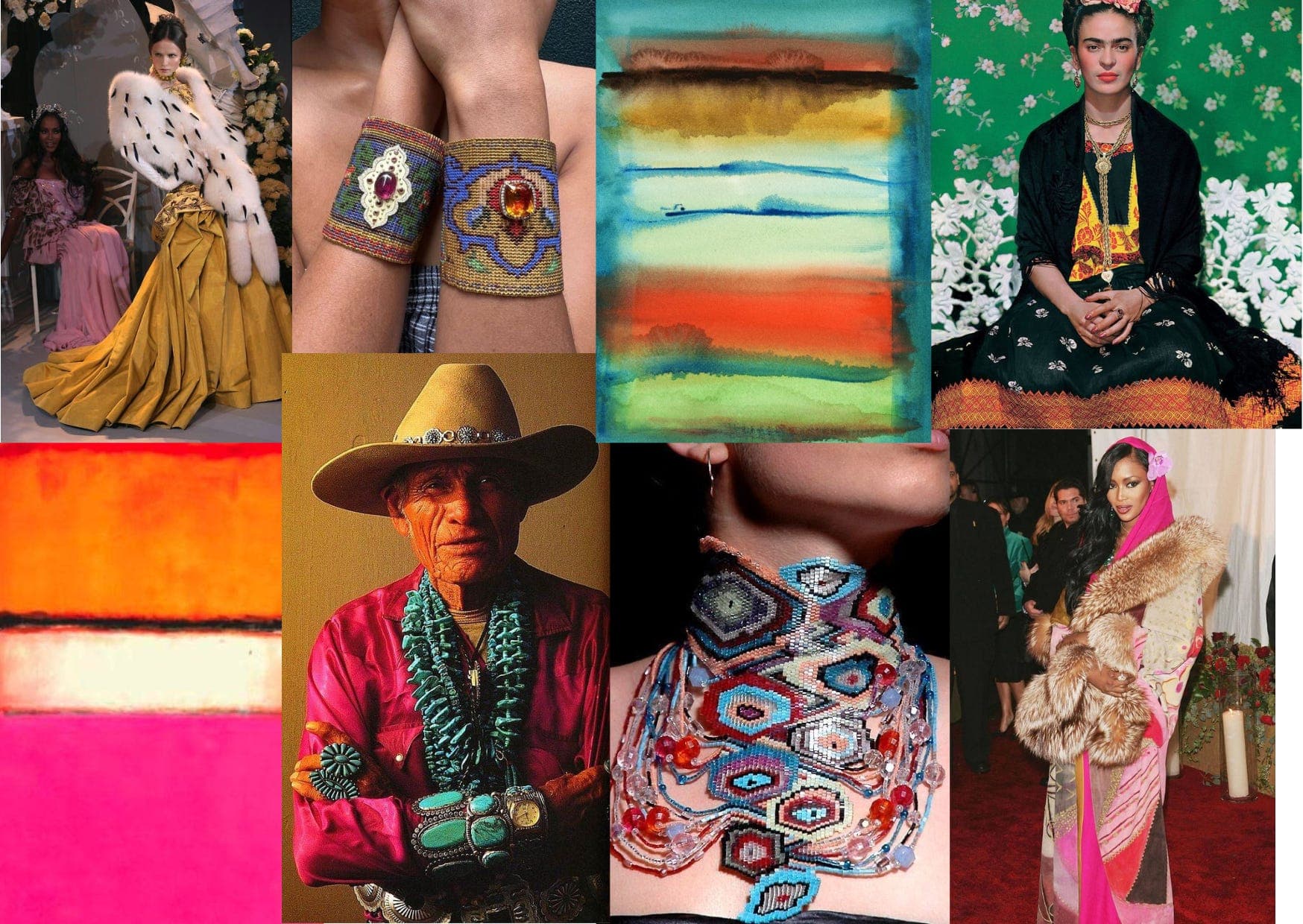
This understanding of art as emotional translation is evident in the work of Mark Rothko, whom I am a great fan of. Rothko's colour field paintings resist literal interpretation yet remain deeply affective and moving. His work shows us that something as simple as colour can carry psychological weight. Fashion operates in the same way. It does not always show meaning, but rather embodies it. A silhouette or texture can communicate context as effectively as the brushwork on a canvas. Similarly, Frida Kahlo is an exceptional example of how identity and visual presentation merge. Her clothing extended her artistic voice beyond painting, shaping how her work permeated into cultural memory and how she is still seen today.
Additionally, a man I admire is Alexander McQueen. His designs turned the runway into a performance, and his work treated clothing almost as sculptures, creating symbolism that provokes an emotional response from the viewer, at least for me that is. The history and experiences that led McQueen to create confronting and assertive clothes shows that fashion is indeed a kind of narrative, or book even.
The gallery is the street, and the artwork and artist is alive, moving through the world.
To view fashion as art is to recognise the body as an active site of the creation of meaning. Clothing becomes language in this way. Fashion translates ones interior into an exterior form of it. Like all art, it communicates what one cannot always say, or feel comfortable saying, directly. So in my eyes, the 'gallery' is the street, and the artwork and artist is alive, moving through the world.
If it was worth your time
What did you make of it?
There are many ways to read a piece of writing and I would like to hear yours — agreement least of all. Whatever you leave sits under this essay only.
Loading…
When there is a new essay
I write when I have something worth saying, which is not often. Leave your email and I will tell you when the next one is up. Nothing else.